10 things a mortgage website needs, and which plan carries each
8 of the 10 are on every plan. The AI Engine arrives with Branch and the Content Engine with Enterprise. None of them quotes a rate, approves a loan or states eligibility; that stays with you.
On every plan: 8 of 10 features.
Pages that open instantly
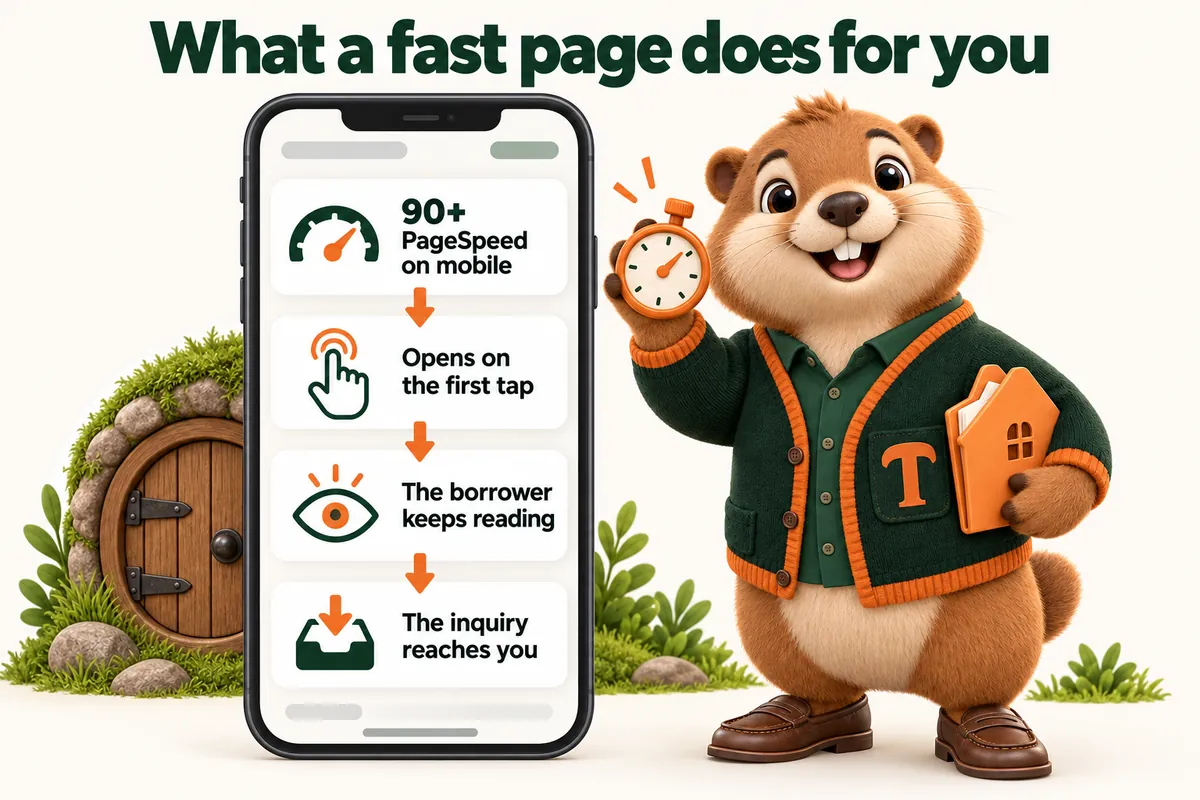
Hand-built static pages served from the edge, 90+ PageSpeed on mobile guaranteed.
Why speed is the first feature on a mortgage website
A borrower who taps your link from a listing agent, a text or a search result decides in the first second whether the page is worth waiting for. We hand-build every page as static HTML, ship almost no JavaScript, and serve it from Cloudflare's edge, so the page is there before the borrower has finished reading the headline. The estimator, the program pages and the application link all load without a spinner. Speed is not a setting we tune later; it is how the site is built, and the 90+ PageSpeed floor is written into your terms.
What we do to keep it fast after launch
Most mortgage sites are fast on launch day and slow six months later, once a chat widget, a rate ticker, three tracking pixels and a video header have been added. We control every script on your site. Anything you ask us to add is loaded only where it is needed and only after the page has painted. Fonts are subset and preloaded, images are converted and sized for the device, and we measure every page against the floor after each weekly update, so the guarantee holds for the life of the plan.
- Solo Originator
- Branch
- Enterprise
Loan program pages
One page for each program you originate, written to answer the questions borrowers actually ask.
What a program page does that a services list cannot
A single "Loan programs" page with nine bullet points ranks for nothing and reassures nobody. A page for conventional, FHA, VA, USDA, jumbo, renovation or whatever you originate gives search engines a document to rank and gives the borrower a place to read at their own pace. Each page explains who the program is typically for, what documents the borrower usually gathers, and what happens after they apply, in plain language, with a clear path to your application and your estimator. It never states rates, terms or eligibility; those are yours to discuss.
How the pages stay compliant
Every program page carries the disclosure block your compliance team approves, your NMLS identifiers, and the equal housing notice, in the same position on every page. When guidance changes, you send one revision and the block updates everywhere at once. The copy is written to describe the program, not to advertise a rate, so it does not trigger the additional disclosures that advertising terms require. If your compliance team wants a sentence changed, that is an ordinary revision, completed within the standard turnaround.
How they fit with the estimator and the application
Each program page ends the same way: an estimator configured for that program's typical structure, and the application link that routes into your LOS or CRM. A borrower reading about renovation loans runs an estimate on a renovation-shaped example, then applies with the program already tagged on the inquiry. Your follow-up begins with the program in hand rather than a blank "interested in a mortgage" note.
- Solo Originator
- Branch
- Enterprise
Originator and branch pages
A profile for every loan officer and a page for every branch, each with NMLS details in the right place.
What an originator profile carries
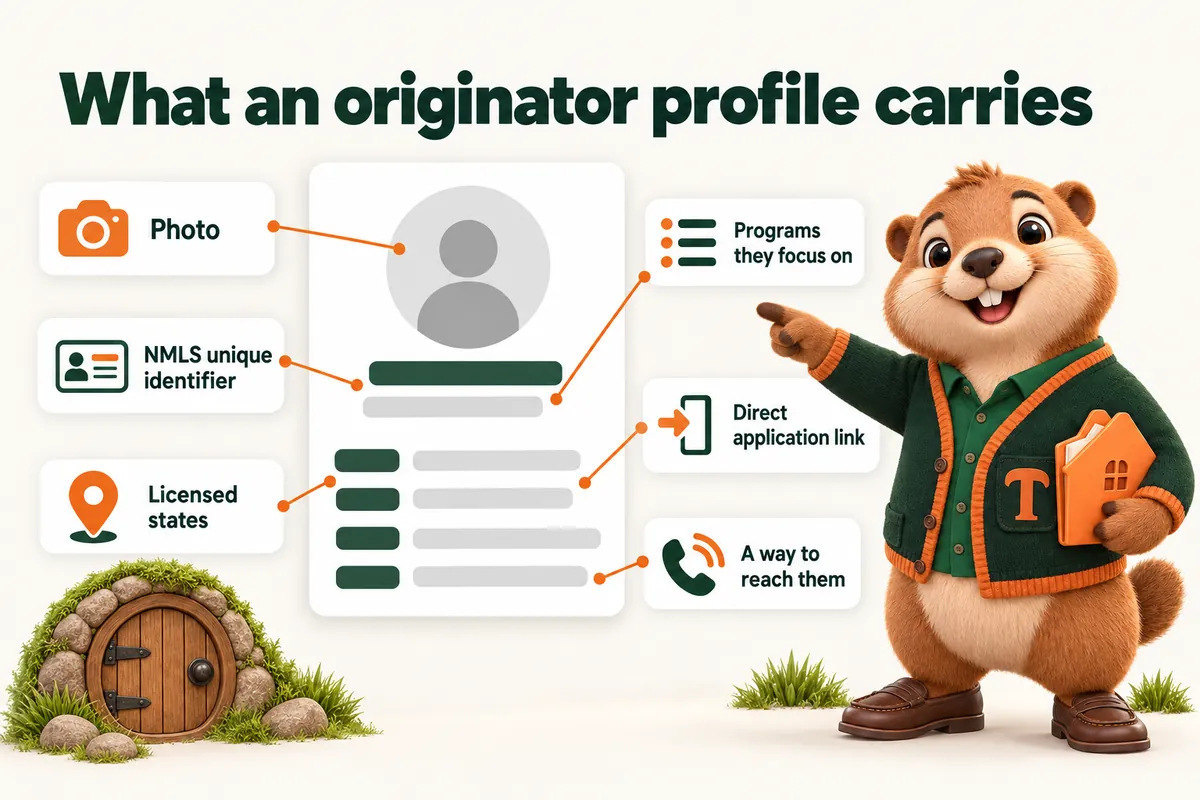
A borrower referred by name searches that name. The profile page they find carries the originator's photo, their NMLS unique identifier, the states they are licensed in, the programs they focus on, a short plain-language introduction, their direct application link and a way to reach them. On a Solo Originator plan this is the heart of the site. On a Branch or Enterprise plan every originator gets one, in the same structure, so the branch looks like one business rather than a dozen personal brands with different fonts.
What a branch page does for local search
A branch page is written for the city the branch serves. It carries the address, hours, the team, the programs that matter locally, directions and the branch NMLS identifier, and it links to each originator's profile. Search engines treat it as the branch's document for that place, which is what lets a branch in one city rank without competing with the corporate site or with branches two states away. Enterprise plans add a region structure above the branches so the hierarchy is clear to crawlers and to people.
- Solo Originator
- Branch
- Enterprise
Application path into your CRM or LOS
Every inquiry, estimate and application click lands in the system you already work in.
Where inquiries go
Nothing on the site sits in a web inbox. A contact form, a callback request, a pre-qualification inquiry and a completed estimate are all sent to your CRM, your LOS lead intake or both, by API where the platform offers one, or through Zapier or Make where it does not. Each record arrives with the page it came from, the program if there was one, and the estimator inputs if the borrower ran one. Your existing follow-up sequences fire as they would for any other lead.
How the application link is handled
Most originators already have a hosted application from their LOS or point-of-sale vendor. We do not replace it. The site's "Apply" links carry the originator, branch and program into that application as parameters wherever the vendor supports it, so the borrower lands in the right originator's application with the right program preselected. If your vendor supports an embedded application, we place it on a dedicated page with the same disclosures as the rest of the site.
Forms that ask only what you need
A borrower on a phone abandons a long form. Our forms ask for the contact details and the one or two facts you need to route the inquiry, and nothing that belongs in the application itself. No income, no social security numbers, no document uploads on the marketing site. That keeps the form short, keeps sensitive data inside the systems built to hold it, and keeps the marketing site out of scope for the controls those systems carry.
- Solo Originator
- Branch
- Enterprise
Payment estimator
An illustrative monthly figure from a price, a down payment, a term and the rate you publish, captured as a lead.
What the estimator shows and what it never claims
The borrower enters a purchase price, a down payment, a term and, if you choose to publish one, a rate; the estimator shows an illustrative principal and interest figure and, optionally, illustrative taxes and insurance placeholders you set. It is labeled on the page as an estimate, not a quote, an offer, a rate lock or a pre-approval, and it never states that anyone qualifies for anything. You decide whether a rate appears at all. If it does, your compliance team supplies the wording and the disclosures that must accompany it, and we place them exactly where they are told to go.
Why every estimate is a lead
The estimator asks for a name and a way to reach the borrower before it shows the figure, or after, depending on the flow you prefer. Either way the inputs and the result are sent into your CRM or LOS as a lead with context: price range, down payment, term and the program page they came from. Your first call starts with a picture of what the borrower is trying to do, rather than with the questions you would otherwise spend the first ten minutes asking.
How it is configured per audience
A reverse mortgage specialist, a commercial lending team and a purchase-focused loan officer need different inputs and different wording. Each audience page on this site describes the configuration we start from. The wording, the defaults and the disclosure text are yours to approve before launch and yours to change afterwards as a standard revision.
- Solo Originator
- Branch
- Enterprise
Weekly detail updates
Team changes, program changes, hours, disclosures and licensing lines, updated within days rather than quarters.
What counts as an update
An originator joins, another leaves, a state license is added, a program is retired, the branch moves, compliance changes the footer wording, a photo needs replacing. Each of these is a revision: you email it, we make it, and it is live within 2 to 5 working days. Five revisions a month are included on every plan and there is no size limit on a revision, so a single request can carry a whole batch of team changes. After five, each additional revision is a flat fee rather than an hourly estimate.
Why this matters more in mortgage than in most niches
A mortgage website with an originator who left last quarter, a license line that is out of date, or a disclosure that no longer matches guidance is not just stale; it is a compliance exposure. The reason most sites drift is that changing them is slow and expensive. On a managed plan, the change is a short email and it is done inside the week, which is what makes it realistic for a branch manager to keep the site accurate without a dedicated marketing hire.
- Solo Originator
- Branch
- Enterprise
Researched articles
Two researched, cited articles a week on tiers 1 and 2, three a week on Enterprise, written for borrowers and reviewed for claims.
What the articles are about
The articles answer the questions borrowers type before they call anyone: what a pre-approval letter is, what happens at closing, how a home inspection differs from an appraisal, what documents a self-employed borrower usually gathers, how a renovation loan draws are paid out. Each is 2,500 to 3,200 words, structured with a table of contents and a short answer at the top, cites its sources, and links to your program pages and your estimator. They are written to be useful to a borrower and to rank for the long questions your competitors' sites never answer.
What the articles never do
They never quote a rate, never state that a reader qualifies, never predict the market and never give advice about a specific situation. Every article carries a line saying it is general information and that the reader's own loan officer discusses their circumstances. If your compliance team wants to review articles before they publish, we schedule them a week ahead and hold them for approval; if they want a topic list to sign off each month, we send one.
- Solo Originator
- Branch
- Enterprise
Managed hosting
Cloudflare hosting, SSL, backups, monitoring and your domain, all inside the monthly fee with nothing itemized.
What hosting includes
The site is served from Cloudflare's network with a certificate that renews itself, a firewall in front of it, daily backups and uptime monitoring that pages us rather than you. A domain is included if you need one, or we point the one you own. There is no hosting line, no SSL line, no "premium CDN" upsell and no plugin license renewals, because there are no plugins. The monthly fee is the whole cost of keeping the site online.
What happens if you leave
Your domain is always yours. If we registered it, it is in your name and we transfer it on request. On cancellation we provide an export of your content and your articles within 14 days. We would rather you stayed because the site keeps earning its fee than because leaving is hard.
- Solo Originator
- Branch
- Enterprise
AI Engine
An AI receptionist, site chat, SMS, Messenger and Instagram agents, call-analysis PDFs and A2P 10DLC registration, on Branch and Enterprise.
What the agents do for a mortgage business
The AI receptionist answers the branch line when nobody can, takes the borrower's details and the program they are asking about, and books a call with the right originator. The site chat and messaging agents answer questions about the branch, the team, hours, what to bring to a first meeting and how to start an application, and hand the conversation to a person the moment it goes beyond that. Each call produces a short analysis PDF so the originator knows what was said before calling back.
What the agents are told never to do
The agents are configured never to quote a rate, never to say whether someone qualifies, never to discuss a specific borrower's file and never to give financial advice. Anything of that kind is handed to a person with a summary. You review and approve every script before launch, and your compliance team can change any line as a standard revision. Text messaging requires A2P 10DLC carrier registration, which we file for you; carrier fees pass through at cost, and usage is billed monthly in arrears.
- Solo Originator
- Branch
- Enterprise
Content Engine
Three articles a week, three social image posts a week, two reels a week and a managed Google Business Profile, on Enterprise.
What the Content Engine produces
On the Enterprise plan the article schedule rises to three a week, and we add three designed social image posts a week and two short reels a week, each built from the same researched material so the message is consistent across the site and the feeds. The Google Business Profile for each branch is managed too: hours, photos, posts, questions and review replies, kept current so the branch shows correctly in the map results borrowers see first.
How it stays inside your compliance lines
Social posts and reels follow the same rules as the articles: no rates, no qualification claims, no predictions. Each carries the identifiers and the disclosures your compliance team specifies for social media, in the format each platform allows. Every month you get the schedule ahead of time and can pull or change anything before it publishes. Nothing about the Content Engine requires anyone at the branch to log in anywhere.
- Solo Originator
- Branch
- Enterprise
What clients say the work changed
“If you only look at the design you miss the best bit, which is the inquiry form. It collects purchase or refinance goal, property state and callback time up front, so the back-and-forth we used to do by reply has largely gone. It has quietly removed the slowest step in our intake.”
What they got: Inquiry form and response workflow for home loan consultations
“Most of our visitors are on phones, so that is where I reviewed the new home loan consultations pages. Everything a visitor needs is up top, and the inquiry button stands out properly. It is far more practical than the old page when we share it with a caller.”
What they got: Mobile navigation and page layout for home loan consultations
“They asked to see the questions customers genuinely ask us about home loan consultations, which I respected. The recurring questions were pulled out, rewritten clearly, and approved line by line by our team. New starters read it too; it has become our reference, not just the customers'.”
What they got: FAQ research and editorial review for home loan consultations
A faster page makes the ads you already run go further
If you or your branch buy clicks, the landing page is the half of the spend nobody manages. Here is the mechanism, in order, with no promised percentage attached to it.
You pay for the click before the page loads
A borrower taps your ad and the money is already spent. Whatever happens next decides whether that spend produced an inquiry or nothing at all. On a slow page a share of those visitors leave before the headline paints, and you paid for every one of them.
Your landing page opens at 90+ PageSpeed
Every page we build is static, hand-coded and served from the edge with almost no JavaScript, and it is measured against the 90+ floor after each weekly update. The program page, the estimator and the apply link are there on the first tap, on a phone, on a weak signal in a parked car outside a listing.
The page matches the ad that was clicked
We build a page per loan program and a profile per originator, so an ad about a renovation loan can point at a renovation loan page instead of a homepage. Google describes landing page experience as how relevant and useful the page is to people who click the ad, and consistency between the ad and the page is what it is measuring.
Better ad quality can lower what you pay per click
Google names the quality of your ads and landing page as one of the six factors in Ad Rank, and says higher quality ads can often lead to lower costs per click. We cannot promise a number and will not pretend to. What we can do is build the landing page so that the part of the equation you control is not the part holding you back.

What we are not saying. We are not claiming a cost per click, a Quality Score or a position. Google treats Quality Score itself as a diagnostic rather than an auction input, and no agency controls an auction. The claim here is narrower and checkable: a page that opens instantly and answers the ad it came from is the version of your landing page that gives your money the best chance, and that is the page we build and keep building.
How the pages are built to stay fastSources: Google Ads Help, About Ad Rank, read September 21, 2026Google Ads Help, About Quality Score for Search campaigns, read September 21, 2026
Found by search engines, answer engines and AI assistants
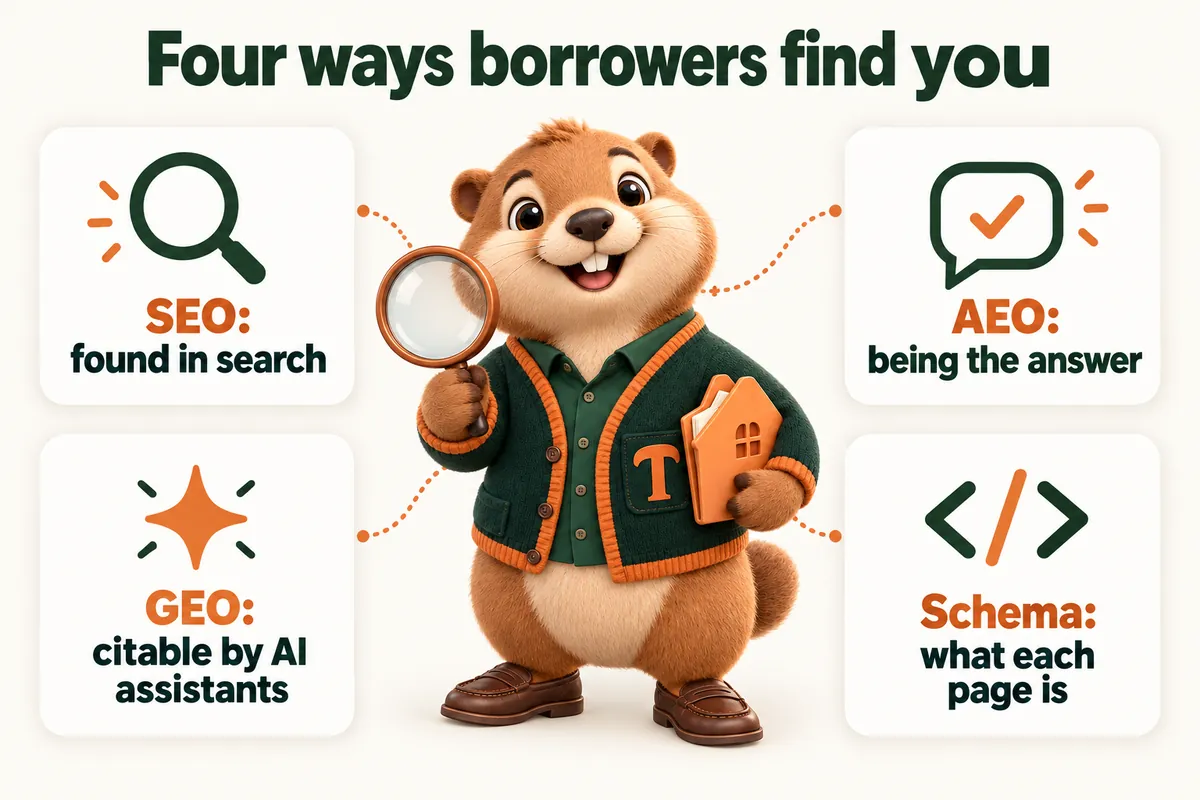
Four separate jobs, all included, all done by us. Here is what each one actually means for a mortgage business, without the acronym doing the talking.
- SEO
Being found in search
SEO is the work that makes a search engine able to find, understand and rank your pages.
On the technical side that is clean static HTML, one canonical URL per page, correct status codes, fast rendering, a sitemap index and a robots file that does not accidentally block anything. On the page side it is a real title and description per page, one H1, headings in order and copy that answers the question in its heading. The structural part is the one most mortgage sites miss: a page for each loan program, a page for each branch city and a profile for each originator, because a search engine can only rank a document that exists.
- Technical build: static pages, canonicals, schema, sitemaps, redirects handled on migration
- On-page: one target phrase per page, titles and descriptions written per page, never duplicated
- Location and service-area pages for the cities your branch actually serves
- 2 researched articles a week aimed at the long questions borrowers type first
- AEO
Being the answer, not just a link
AEO is writing so that the answer can be lifted cleanly out of your page and shown as the answer.
Search results, voice assistants and AI summaries all pull short, self-contained answers out of pages. A page that buries its answer in the fourth paragraph does not get pulled. So every section on a site we build opens with the direct answer to its own heading, headings are written the way people actually ask, key terms get a short definition block, and every significant page carries its own set of questions with full answers marked up as FAQ content that is visible on the page rather than hidden in the markup.
- Answer-first paragraphs under question-shaped headings
- Page-specific FAQ blocks, visible to readers and marked up for engines
- Comparison tables and summary blocks written to be quoted whole
- Definitions for the terms borrowers do not know yet, in plain language
- GEO
Being citable by AI assistants
GEO is making your site easy for an AI assistant to read, attribute and quote correctly.
Borrowers increasingly ask an assistant before they ask a person, and assistants such as ChatGPT, Claude, Perplexity and Google AI Overviews summarize from pages they can parse. We publish a plain-text index of the site at llms.txt and an expanded version at llms-full.txt, keep your business name, identifiers and service names written identically everywhere so the entity is unambiguous, state facts plainly with dates attached, and leave the content readable without JavaScript. Nobody can guarantee an assistant will cite a site, and we do not. This is the work that makes it possible.
- llms.txt and llms-full.txt generated from the site and kept current
- One consistent business name, identifier and service vocabulary across every page
- Facts stated plainly with published and updated dates visible
- Crawler directives set deliberately, and stated, rather than left to a default
- Schema
Telling engines what each page is
Structured data is a machine-readable description of the page, generated from the same content a visitor reads.
Your site ships with Organization or LocalBusiness data for the business, Service data for what you offer, FAQPage data for the questions on a page, BreadcrumbList for where the page sits, and Person data for each originator profile. It is generated from the content, so it cannot drift away from what the page says a month later, and we only ever mark up what is visible. Review markup is only added when there are real, published client reviews to attach it to.
- Organization or LocalBusiness, Service, FAQPage, BreadcrumbList and Person, generated from your content
- Only ever describing what a visitor can actually see on the page
- Validated before launch and re-checked when pages change
- Review markup only where a real, published review exists
Two honest limits. We do not buy links, and we do not promise a position, because nobody can. The ranking commitment in your terms is the one we can keep: the site starts ranking for local searches within 3 to 5 months of launch, or we keep working at no extra charge.How the search work is done
The compliance pages come with the website
Every site we build ships with the policy pages a real business needs, written for your site rather than pasted from a generator, plus the mortgage-specific blocks. They are built to help you meet your obligations. They are not legal advice, and the decisions stay with you and your compliance team.
Privacy policy
Written for your site: what the forms collect, where inquiries are sent, who processes them, how long they are kept and how someone asks for their data. It names your actual tools rather than describing a generic website.
Terms of use
The terms for using your website, including what the estimator is and is not, and a plain statement that nothing on the site is an offer, a commitment to lend or advice.
Cookie policy with consent that actually gates
The banner is wired so analytics and marketing tags do not fire before consent, and the policy lists what the site really sets. A banner that blocks nothing is worse than no banner at all.
Accessibility statement
Your site is built with WCAG 2.2 AA in mind: keyboard operation, visible focus, contrast checked in both themes, real alt text, 44 pixel tap targets. The statement says what we target and how a visitor reports a problem, which is the honest version of an accessibility page.
Disclaimer
A clear statement that the site is informational, that figures shown by an estimator are illustrative, and that nothing on it is a rate quote, an offer, a rate lock or a pre-approval.
NMLS and licensing block
Your company and individual NMLS identifiers, your licensed states and the equal housing notice, placed in one definition and rendered identically on every page. When your compliance team changes a word, it changes everywhere at once.
Consent wording on forms that text people
Where a form or an agent sends SMS, the consent language your compliance team specifies sits with the field it belongs to, and the A2P 10DLC carrier registration is filed for you on the plans that include messaging.
Advertising review built into the launch
Nothing goes public before the people who sign off your marketing have seen it. We hold launch for that review, and afterwards a wording change is an ordinary revision rather than a project.

What we never do: write your disclosures for you, decide what your regulator expects, quote a rate, state that a borrower qualifies, or describe anything on your site as guaranteeing compliance. We place the wording you give us, in the position you specify, and change it inside the week when you say so.Read our own disclaimer
See every one of these on a site built for you.
Plans $137 a month. The build fee comes after launch. Cancel any month.