A documented page model
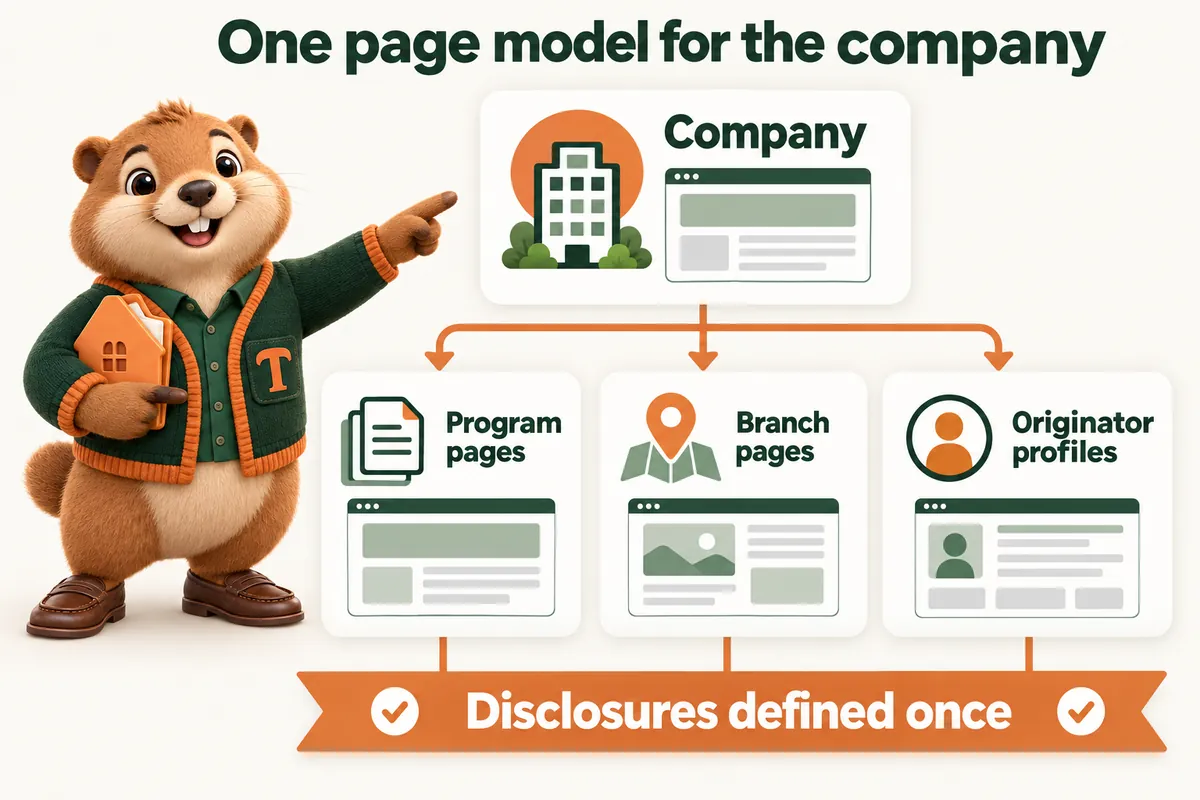
Company, program, branch and originator pages with defined relationships, so growth never means a redesign.
Who it's for
Originators
Specialists
Features
The site
Services
Design and build
Grow and scale
Resources
A mortgage company site has to do three things at once: sell the company to borrowers, give every branch and originator somewhere credible to send a referral, and keep compliance wording identical on every page it appears. Design for one of those and you break the others. We build the structure first, so that adding a branch, a program or an originator never means renegotiating the design, and a disclosure change reaches every page in the same release.
What it costs
The first design decision on a company site is not color, it is the page model. How does a program page relate to a branch page. Where does an originator profile live and what does it inherit. What happens when a branch offers a program the company does not offer everywhere. We settle that model with you before anything is styled, because it is what determines whether the site can grow. Companies that skip this end up with a marketing site and a separate, worse site for each branch, which is where inconsistent disclosures and out-of-date licensing lines come from. One model, applied everywhere, is both the cheaper design and the safer one.
Company sites accumulate. A recruiting page, a servicing page, a careers page, a community page, a page for a new regional partnership. If the design is a set of bespoke layouts, the tenth addition looks nothing like the first. We ship a system instead: a defined palette with light and dark both handled, one type pairing, one radius, a fixed set of section patterns and a documented component for every repeated element. New pages are assembled from that system, which is why they are quick to add and why they still look like the same company a year later. It also makes handovers to an internal marketing team straightforward, if that is where this eventually goes.
Most mortgage company sites are written entirely for borrowers, and then head office wonders why the careers page gets no traction. An originator considering a move is evaluating the same site, and they are looking for different things: what the technology stack is, how fast the site their name will sit on actually is, what marketing support exists, and whether the branch pages look like somewhere they would want their profile. We design that audience a real path rather than a form at the end of a paragraph, and keep it clearly separated from the borrower path so neither one dilutes the other.
Compliance wording on a company site appears in the footer, on program pages, on branch pages, on originator profiles and inside articles. Changing it by hand across all of those is how sites end up with three versions of the same disclosure live at once. In our build it is defined in one place and rendered everywhere, so a change is one revision. Those revisions are 5 a month included, any size, each completed within 2 to 5 working days, raised in your client portal and tracked, which also gives your compliance team an audit trail of what changed and when.
Company, program, branch and originator pages with defined relationships, so growth never means a redesign.
Palette, type, radius and section patterns defined as tokens, so every future page matches without anyone policing it.
Disclosures, equal housing wording, identifiers and licensing lines inherited by every page that needs them.
A separate route for the audience deciding whether to bring their book to you, kept clear of the borrower path.
By branch, by program or by geography, delivered into the CRM or LOS the company already runs on.
Every revision raised and tracked in the client portal, so what changed and when is answerable months later.
“If you only look at the design you miss the best bit, which is the inquiry form. It collects purchase or refinance goal, property state and callback time up front, so the back-and-forth we used to do by reply has largely gone. It has quietly removed the slowest step in our intake.”
What they got: Inquiry form and response workflow for home loan consultations
“Most of our visitors are on phones, so that is where I reviewed the new home loan consultations pages. Everything a visitor needs is up top, and the inquiry button stands out properly. It is far more practical than the old page when we share it with a caller.”
What they got: Mobile navigation and page layout for home loan consultations
“Before this, sending our home loan consultations form felt like posting a letter into the dark. Submitters now see exactly what we will do with their request and when to expect us. It is a small corner of the site that makes the whole process feel finished.”
What they got: Submission acknowledgment and follow-up for home loan consultations
Client projects where this service did the heavy lifting, start to finish.
Yes, as a subdomain or a directory, whichever your IT policy allows. We will talk through which option is likely to serve your local pages better and which fits the policy, and the decision is yours.
You do. The copy, the images and the articles are yours, the domain is registered in your name, and we export everything within 14 days of cancellation. Nothing is held hostage.
They can send us anything to publish and it goes live within the standard revision turnaround. There is no CMS login to manage, which is deliberate: it is what keeps the structure and the disclosures consistent as the site grows.
The program page describes the program in general terms and the availability is expressed per branch or per state, rather than as a blanket claim. We never state that an individual qualifies for anything, and where a program is limited the page says so plainly.
Yes. We build to the wording your compliance team or vendor supplies and give them a review link before launch and before any material change. Approval and the advertising rules themselves stay on your side.
By defining the page once and generating the rest from your data rather than building thirty pages by hand. Identifiers, licensed states, disclosure wording and the equal housing notice are a single definition rendered identically everywhere, so a compliance change is made once and reaches every profile at the same moment. Photos, focus programs and contact details vary per person, which is exactly what should vary.
Whoever you nominate, and we build the process around them rather than around us. On the onboarding call we ask for the name of the person who approves marketing copy and the person who approves disclosure wording, which are often different people. Launch is held for both. After launch, changes in the categories they care about are routed to them before they go live if that is what you want.
Yes. Company-level elements such as the disclosure block, the program descriptions and the brand are defined centrally, and branch-level elements such as the address, hours, team and local copy sit with the branch. Requests still come through us, so a branch cannot quietly publish something head office has not seen, which is usually the actual worry behind this question.
A live walk-through of the site you would get, in about 30 minutes. Plans from $137 a month, the $797 build fee invoiced only after launch, domain and hosting included.
Book a demoOr email and a person replies within one working day.
MortgageWebStudio uses the cookies below. Necessary cookies keep the site working and cannot be turned off.
Saved on this device only. Press Esc to close.