The broker case, written plainly
A short page on why borrowers use a broker, concrete and specific, with no outcome claim we cannot stand behind.
Who it's for
Originators
Specialists
Features
The site
Services
Design and build
Grow and scale
Resources
A mortgage broker site has a harder design job than a loan officer site, because it has to explain a choice rather than present a person. The borrower needs to understand why going through you beats walking into a bank, without the page turning into a wall of lender logos that makes you look like a comparison portal. That means designing the argument first, the loan types second, and the lender relationships as supporting evidence rather than as the headline.
What it costs
Most broker sites open with a slogan and a lender wall. A borrower reads that and concludes you are a search engine for loans, which is neither flattering nor true. The stronger opening is the argument itself: you place with many lenders, so a file that does not fit one has somewhere else to go, and you do that work rather than the borrower doing it. We design that as a short, concrete sequence near the top of the site, in your words, with no claim about outcomes we cannot support. Lender relationships then appear where they are useful, on the loan type pages, as evidence that the choice is real. It changes the whole feel of the site from aggregator to adviser.
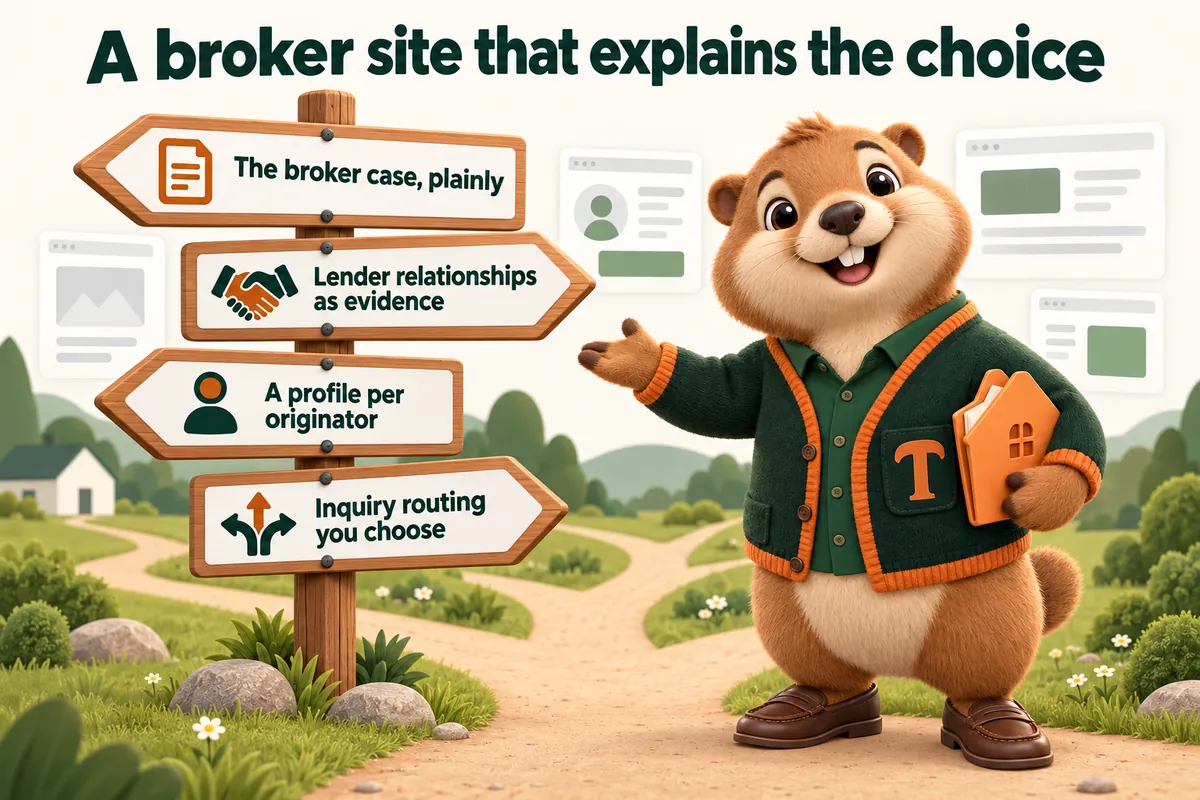
Brokers usually place a wider range than a retail originator, and a single "loan programs" page flattens all of it into bullet points. We give each type its own page: conventional, FHA, VA, USDA, jumbo, non-QM, bank statement, DSCR, construction, renovation, reverse, commercial, whatever your book really contains. Each page describes who the program tends to suit in general terms, what documents are usually involved, and what the next step is, without stating eligibility for any individual. That structure gives borrowers something to read at their own pace and gives search engines a document to rank for the program searches in your area, which one combined page never does.
A brokerage is rarely one person. The design has to hold a team page, a profile for each originator with their own identifier, and a routing rule for what happens when an inquiry arrives with nobody named on it. We design the profile template once so every originator page looks like it belongs to the same business, and we design the inquiry path so it can go round-robin, by loan type, or to a single desk that triages. New originators are added as a revision, so the page exists the week they start rather than the quarter after.
No rate table, no live pricing widget, no "get approved in minutes" badge, no countdown. A rate on a broker site is stale the moment it renders and creates an advertising exposure you do not need. An approval promise is worse. We leave them out and put the effort into the things that do persuade: a clear explanation of what you do, honest program pages, an estimator that says plainly it is an estimate rather than a quote, an offer or a pre-approval, and a fast, quiet interface that makes the business look well run. Compliance with advertising rules, licensing and disclosure remains yours; the design gives it somewhere sensible to live.
A short page on why borrowers use a broker, concrete and specific, with no outcome claim we cannot stand behind.
Conventional through non-QM and commercial, each with its own page rather than a line in a shared list.
One layout, one identifier field, one apply link, so a ten-person shop looks like one business rather than ten sites.
Round robin, by loan type, or to a triage desk, delivered into your CRM with the loan type and page attached.
Shown on the pages where they support the argument, never as a logo wall that makes you read as a portal.
An illustrative monthly figure on your domain, clearly labeled, with the visitor captured into your pipeline.
“If you only look at the design you miss the best bit, which is the inquiry form. It collects purchase or refinance goal, property state and callback time up front, so the back-and-forth we used to do by reply has largely gone. It has quietly removed the slowest step in our intake.”
What they got: Inquiry form and response workflow for home loan consultations
“Most of our visitors are on phones, so that is where I reviewed the new home loan consultations pages. Everything a visitor needs is up top, and the inquiry button stands out properly. It is far more practical than the old page when we share it with a caller.”
What they got: Mobile navigation and page layout for home loan consultations
“Before this, sending our home loan consultations form felt like posting a letter into the dark. Submitters now see exactly what we will do with their request and when to expect us. It is a small corner of the site that makes the whole process feel finished.”
What they got: Submission acknowledgment and follow-up for home loan consultations
Client projects where this service did the heavy lifting, start to finish.
Yes, where your lender agreements allow it, and we place them on the loan type pages where they support the argument rather than in a logo wall on the homepage. Some wholesale agreements restrict logo use, so we build to whatever your agreements and compliance team permit.
Yes. We can route round robin, by loan type, by geography or to a single triage desk, whichever matches how your pipeline works. The routing happens on delivery into your CRM, so nothing sits in a shared web inbox waiting for somebody to notice it.
No. We do not display, source or quote rates. If you publish a figure for the estimator that is your decision with your compliance team, and the page states clearly that the result is an estimate rather than a quote, an offer or a pre-approval.
As many as you genuinely place. There is no per-page charge and adding one later is a revision, not a project. What we will push back on is a page for a program you do not actually originate, because it draws inquiries you cannot serve.
No. A two-person brokerage gets the same structure at a smaller scale: fewer loan type pages, two profiles, one routing rule. Plans start on Solo Originator and the site grows through revisions as the book grows.
Describe the mechanism, not the benefit. A page that says you work with a panel of lenders, that the borrower fills in one application rather than several, and that you handle the comparison, is more persuasive than any adjective, because it tells a nervous reader what will actually happen to them. We write it that way and we never state that a broker gets anyone a better rate, because that is a claim about an outcome we cannot make and you should not.
Usually not on the home page, and only where your agreements with those lenders allow it. A wall of lender logos makes a brokerage read as a comparison portal, which is the opposite of the personal relationship most brokers actually sell. A plain sentence about the number and kinds of lenders you work with does the same job without the confusion. If a particular lender relationship is a genuine differentiator, it earns a mention in words.
Yes. Every loan type page ends with the estimator configured for that kind of loan and an inquiry form that tags the submission with the program, so the person in your office who handles that type picks it up first. On plans with the AI Engine the site chat and messaging agents carry the same tag through, so the context is not lost between the page and the follow-up.
A live walk-through of the site you would get, in about 30 minutes. Plans from $137 a month, the $797 build fee invoiced only after launch, domain and hosting included.
Book a demoOr email and a person replies within one working day.
MortgageWebStudio uses the cookies below. Necessary cookies keep the site working and cannot be turned off.
Saved on this device only. Press Esc to close.