An honest read on your current template
A plain assessment of what to keep and what a page-per-program structure would actually add.
Who it's for
Originators
Specialists
Features
The site
Services
Design and build
Grow and scale
Resources
Mortgage website templates are a reasonable way to get a professional-looking site live quickly, and we say that plainly rather than pretending only a fully custom build is legitimate. A template gets you a homepage, an about page and a contact form fast. Where templates tend to run out of road is exactly where a mortgage business gets more complicated: multiple programs, multiple originators, an estimator that needs to keep the lead, and compliance wording that has to be identical across every page.
What it costs
A good template gives a new loan officer a professional-looking site in days rather than weeks, with a sensible layout, working navigation and a contact form that at least reaches an inbox. For someone just starting out with one or two programs and no team to coordinate, that is often enough, and paying for a fully custom structure at that stage can be more than the business needs yet. We say this on our own pricing page too: the lowest plan exists for exactly this situation, and it is not a lesser version of the offer, it is the right size for it.
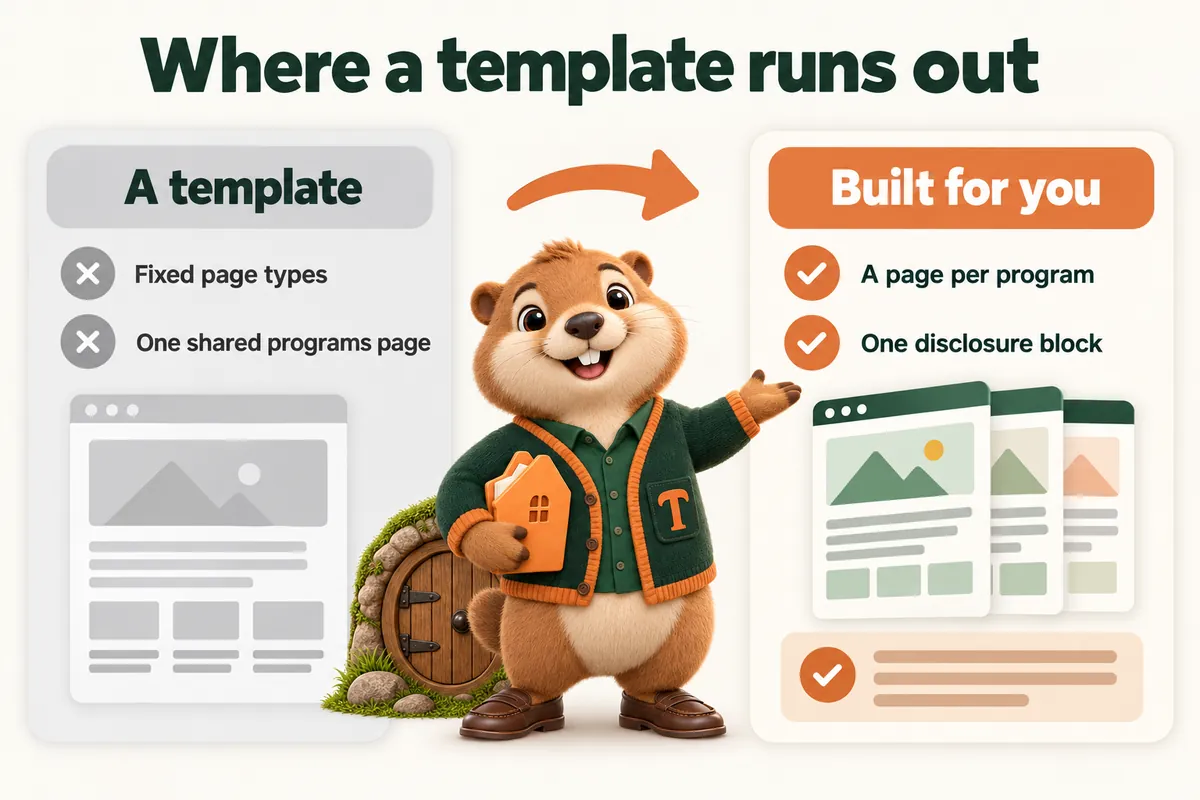
The first sign a template has stopped being enough is a "loan programs" page carrying every program you originate as a bulleted list. Templates are built around a small, fixed set of page types, and adding a genuinely new kind of page, one per program, one per originator, one per branch, usually means custom sections stacked awkwardly into the template's existing structure rather than a page type built for the purpose. The site still technically works, but search engines have nothing dedicated to rank for a specific program search, and a nervous borrower has no page written just for the program they are asking about.
Most templates either have no estimator at all or link out to a third-party calculator, which means the lead that calculator captures is not delivered to your CRM or LOS, it stays with the calculator's owner. Templates also rarely offer a single place to define a disclosure block that automatically appears identically on every page, so compliance wording tends to be pasted in per page, which is how it quietly goes out of sync. If either of these matters to your business today, that is the practical signal a template has stopped being the right fit.
Moving off a template does not mean starting from nothing. Your existing copy, photos and program descriptions are brought across, your current URLs are mapped and redirected so nothing you currently rank for is lost, and the new structure is built around what your business has grown into. It is the same process described on our redesign page, and it typically completes in the same 7 to 15 day range as a first build, because the content already exists; only the structure changes.
A plain assessment of what to keep and what a page-per-program structure would actually add.
Built to replace a shared bullet-point page once your business has outgrown one.
Replacing a linked third-party calculator, so every estimate becomes your lead instead of someone else's.
Replacing wording pasted individually into template pages, which is how it goes out of sync.
Existing URLs mapped and redirected, so moving off the template does not cost you the searches you already win.
If your current template is genuinely still doing the job, we will say so rather than sell you a rebuild you do not need.
“Most of our visitors are on phones, so that is where I reviewed the new home loan consultations pages. Everything a visitor needs is up top, and the inquiry button stands out properly. It is far more practical than the old page when we share it with a caller.”
What they got: Mobile navigation and page layout for home loan consultations
“We approved the new home loan consultations form only after trying hard to break it. Each error is flagged precisely where it happens, and nothing already entered is lost. It behaves the way we assumed forms behaved, until we tested the old one.”
What they got: Form usability and error handling for home loan consultations
“If you only look at the design you miss the best bit, which is the inquiry form. It collects purchase or refinance goal, property state and callback time up front, so the back-and-forth we used to do by reply has largely gone. It has quietly removed the slowest step in our intake.”
What they got: Inquiry form and response workflow for home loan consultations
Client projects where this service did the heavy lifting, start to finish.
Not as a standalone product. Our lowest plan gives a solo originator a complete, professionally built site rather than a generic template, at a price close to what a template subscription plus a calculator plugin plus hosting would already cost separately.
The clearest signs are a single crowded programs page, an estimator that links away from your site, or a team page that cannot cleanly fit a second or third originator. Any one of those is worth a conversation.
We can review it and tell you plainly what to keep. In practice, once a business needs program pages, originator profiles and a real estimator, rebuilding on our structure tends to be more direct than extending a template past what it was designed for.
No, provided it is done properly. Every existing URL is mapped and 301 redirected in the same release the new site goes live, so pages that rank today pass their standing to their new home.
Often not, once a calculator plugin, extra hosting for one, and a developer's hourly rate for every change are added up. Our plans fold hosting, the estimator and revisions into one monthly fee with no itemized extras.
At the point where your business has more structure than the template has slots. One originator, four programs and one city fits almost any template. Eleven originators across two states, nine programs, a compliance block that must be identical everywhere and a city page that has to outrank a national brand does not, and no amount of editing inside the template fixes it, because the problem is the page set rather than the look.
We start from a design direction rather than a theme, and the pages are hand-coded. The three directions we show you are starting points for a conversation about your brand, not products you are choosing between. Two clients who pick the same direction do not end up with sibling sites, because the programs, the team, the cities and the copy are different in every case.
Yes, that is what the demo is for: a live walk-through of the directions and the page structure, with your business in mind. What you cannot do is buy a file and take it away, because what is being sold is a built and managed site rather than a design asset.
A live walk-through of the site you would get, in about 30 minutes. Plans from $137 a month, the $797 build fee invoiced only after launch, domain and hosting included.
Book a demoOr email and a person replies within one working day.
MortgageWebStudio uses the cookies below. Necessary cookies keep the site working and cannot be turned off.
Saved on this device only. Press Esc to close.