Static, hand-coded pages
No page builder, no unused theme framework, nothing running that this particular page does not need.
Who it's for
Originators
Specialists
Features
The site
Services
Design and build
Grow and scale
Resources
Mortgage website development is a build decision as much as a design one, and the decision that matters most is what runs the page. A site built as static, hand-coded pages opens the moment it is requested. A site built on a page builder or a heavy theme sends the browser a construction kit and asks it to assemble the page first. Borrowers on a phone, mid-referral, notice the difference in the first second, before they have read a word.
What it costs
Every page is written as plain, static markup and styling rather than assembled at request time by a page builder plugin. There is no database query standing between a click and the page, no theme framework loading rules it does not need for this particular page, no visual editor leaving behind markup nobody asked for. The estimator and the navigation are the only interactive parts, and they load after the page has already painted. The result is a page that is small, predictable and fast on the connection a referral actually has, not the one a demo video was recorded on.
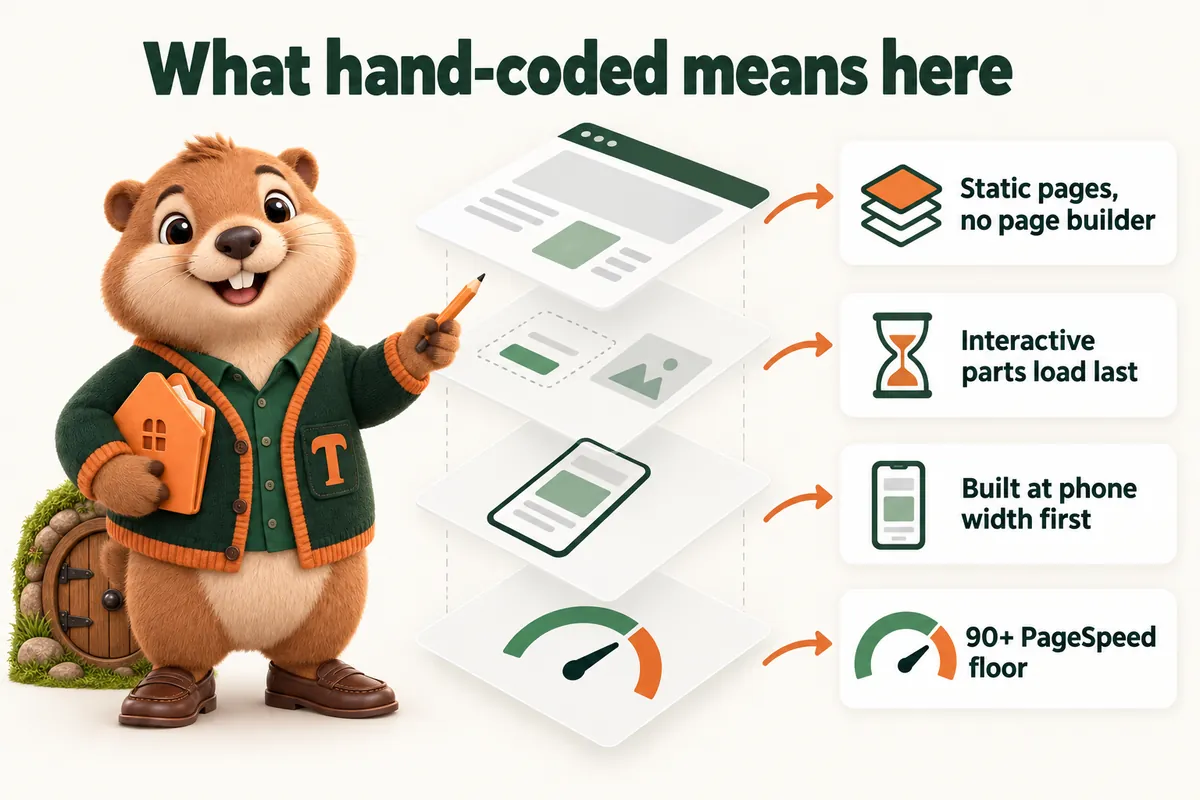
90+ on Google PageSpeed, on mobile and desktop, is written into your terms rather than quoted as a launch-day best case. We control every script that ships on the site, so nothing a plugin update or a tracking pixel adds later can quietly push the score down without us knowing. The score is checked again after every weekly update, not just once at launch. If a page we built falls below the floor because of our work, we fix it at no charge, which is a commitment most development work does not make.
A fast page that dead-ends at a contact form is not a finished build. Development here includes the estimator logic that produces an illustrative figure, and the delivery of every form, callback and estimate into the CRM or LOS you already run your pipeline from, by API, Zapier or Make. The inquiry arrives tagged with the page and the program it came from, so nothing lands in a shared inbox waiting for somebody to notice it. That connection work is usually the part a template or a freelance build skips.
A site is not finished the day it ships in this business, because licensed states, team members and disclosures keep changing. Development continues as 5 revisions a month, of any size, completed within 2 to 5 working days, so a build stays a build rather than becoming a frozen artifact from launch day. Weekly updates keep the details current, and researched articles keep being added, which is development work most agencies stop billing for the moment the invoice for the build is paid.
No page builder, no unused theme framework, nothing running that this particular page does not need.
Written into your terms and rechecked after every weekly update, not measured once on launch day.
Built as real logic on your domain, producing an illustrative figure and capturing every run as a lead.
Forms, callbacks and estimates arrive automatically, tagged with the page and program they came from.
Disclosures, identifiers and licensing lines defined centrally so a change reaches every page together.
Cloudflare's edge network, included, so the fast pages we build are served from somewhere fast too.
“Most of our visitors are on phones, so that is where I reviewed the new home loan consultations pages. Everything a visitor needs is up top, and the inquiry button stands out properly. It is far more practical than the old page when we share it with a caller.”
What they got: Mobile navigation and page layout for home loan consultations
“Our deliberately awkward question was: what if the home loan consultations form breaks? The answer became a published fallback plus a delivery check we can run ourselves. That attention to the invisible parts of the site gave me confidence in the handover.”
What they got: Contact resilience and delivery checks for home loan consultations
“If you only look at the design you miss the best bit, which is the inquiry form. It collects purchase or refinance goal, property state and callback time up front, so the back-and-forth we used to do by reply has largely gone. It has quietly removed the slowest step in our intake.”
What they got: Inquiry form and response workflow for home loan consultations
Client projects where this service did the heavy lifting, start to finish.
No. Pages are hand-coded and static, which is the main reason the speed floor holds after launch instead of decaying as plugins accumulate. There is nothing to update, patch or get hacked, because there is no plugin ecosystem running underneath the site.
Usually yes, through an API, a Zapier automation or a Make scenario, whichever your LOS or CRM supports. We confirm the exact method on the onboarding call once we know your system, and it is built into the site before launch.
You raise it in your client portal. 5 revisions a month are included, any size, completed within 2 to 5 working days, so development work does not stop the day the build fee is invoiced.
Only a rate you choose to publish as an input to an illustrative figure. The development never sources, quotes or suggests a rate on its own, and the result is always labeled as an estimate rather than a quote, an offer or a pre-approval.
The pages themselves might look similar. What is usually missing from a freelance build is what happens after launch: the weekly updates, the revisions, the monitoring and the guaranteed speed floor. Development does not stop here when the invoice does.
It means the page a borrower receives contains only what that page needs, rather than a general-purpose template loading everything in case a page uses it. There is no page builder output, no plugin stack and almost no JavaScript. In practice that is the difference between a page that is painted on the first tap and a page that shows a spinner while a script decides what to render, which is the entire experience on a weak signal.
Not to the build, and this is the honest trade. The domain is yours, the content is yours and it is exported on request, but the codebase and the hosting are ours to run, which is how the speed floor and the revision turnaround can be committed to in writing. If owning the code matters more to you than either of those, a self-hosted platform is the right answer and we will say so.
Every script that goes on the site goes through us, and anything you ask us to add is loaded only on the page that needs it and only after that page has painted. Fonts are subset and preloaded, images are converted and sized per device, and every page is re-measured against the floor after each weekly update. Most mortgage sites are fast at launch and slow six months later for exactly the reasons this paragraph describes.
A live walk-through of the site you would get, in about 30 minutes. Plans from $137 a month, the $797 build fee invoiced only after launch, domain and hosting included.
Book a demoOr email and a person replies within one working day.
MortgageWebStudio uses the cookies below. Necessary cookies keep the site working and cannot be turned off.
Saved on this device only. Press Esc to close.