One branch template for every location
Consistent structure across every branch, so growth is additive rather than a series of one-off rebuilds.
Who it's for
Originators
Specialists
Features
The site
Services
Design and build
Grow and scale
Resources
Multi-branch mortgage websites have to solve a problem a single-branch site never faces: keeping every branch, every originator and every disclosure consistent while each individual branch still ranks for its own city. Do it by hand across a dozen branches and disclosures drift, page quality varies by whoever built each one, and a compliance wording change becomes a project instead of an edit. Structure it once, properly, and adding branch thirteen looks exactly like adding branch two.
What it costs
The foundation of a multi-branch site is a single, well-designed branch page template, used identically for every location rather than each branch getting a slightly different one-off build over time. Every branch page carries the same fields: address, hours, local team, licensed states, branch identifier and a link to relevant programs, populated per branch. That consistency is what makes a fiftieth branch as fast to add as the second, and it is what keeps every branch looking like it belongs to the same, well-run company rather than a patchwork accumulated over years.
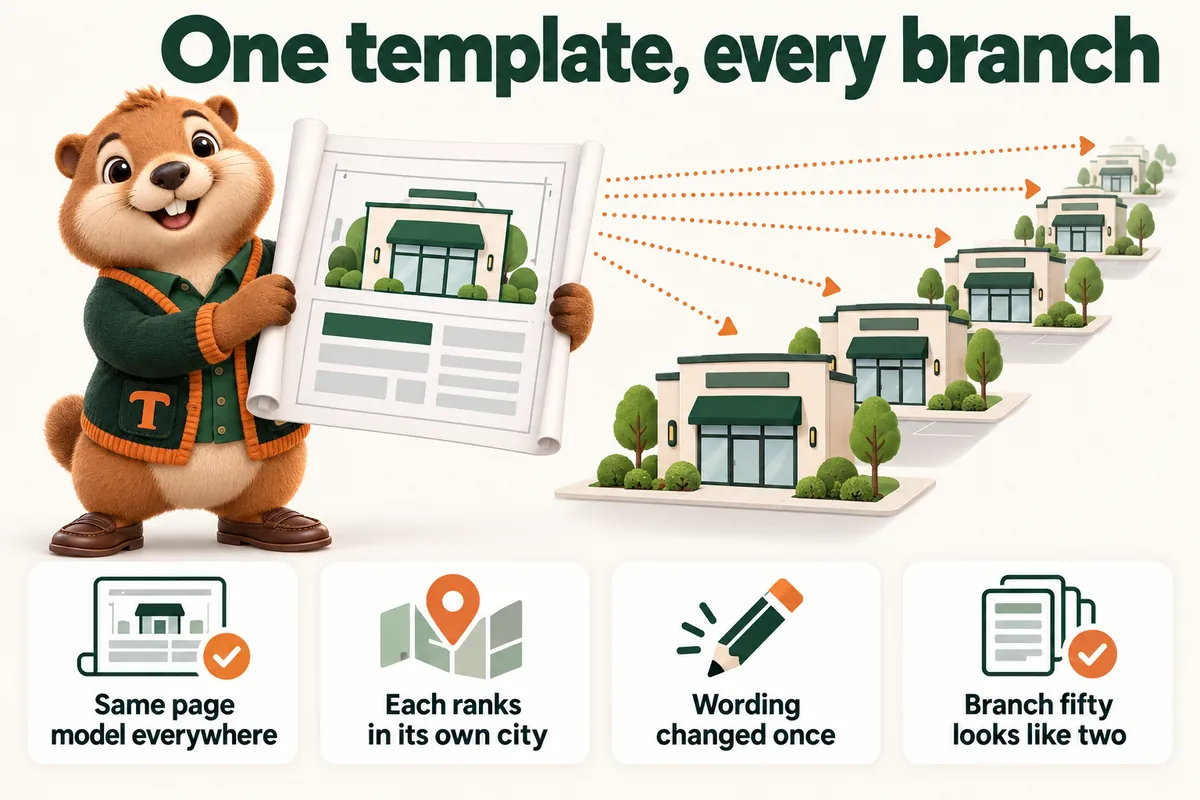
Across many branches, a disclosure or licensing wording change made by hand on each page individually is exactly how inconsistencies creep in: branch four gets the update, branch nine does not, and nobody notices until an audit finds it. Because the disclosure, the equal housing statement and the identifier fields are defined once in the underlying structure and inherited by every branch page, a wording change from your compliance team reaches every branch within 2 to 5 working days, the same as any other revision, with a single, traceable change rather than a dozen separate edits.
A common mistake in multi-location sites is branch pages that are copies of each other with only the city name changed, which search engines recognize as thin, duplicate content and tend not to rank well. Each branch page here carries genuinely distinct content: its own team, its own hours, its own licensed states, and where relevant its own program mix, so the pages are similar in structure but different in substance. That is the difference between fifty pages that each earn their own ranking and fifty pages competing against each other for the same one.
Head office gets a single place to see what changed and when: every revision across every branch is raised and tracked in the client portal, so a compliance officer can see the change history for branch six as easily as branch one. New branches launch on the same 7 to 15 day range as a first build, because the template already exists and only the branch-specific content needs to be gathered. Growth stays administrative, not architectural.
Consistent structure across every branch, so growth is additive rather than a series of one-off rebuilds.
A single, traceable revision updates every branch page, rather than dozens of individual edits.
Local team, hours, licensed states and program mix specific to each branch, avoiding thin duplicate pages.
Adding a new branch is a data-entry task against an existing template, not a new design project.
Every revision across every branch tracked in the client portal, visible to whoever needs to see it.
Leads delivered into the CRM or LOS tagged with the branch and program, so the right team picks them up.
“The audit found our home loan consultations details repeated across several pages, each worded slightly differently. Everything now lives in one maintained reference, with the duplicates retired or redirected. Customers no longer quote wording we retired two years ago.”
What they got: Content audit and update process for home loan consultations
“Our content meetings about home loan consultations used to run on anecdote. Each inquiry records where it began, which is the only number I asked for. Content decisions now start from evidence rather than impressions.”
What they got: Basic inquiry source reporting for home loan consultations
“If you only look at the design you miss the best bit, which is the inquiry form. It collects purchase or refinance goal, property state and callback time up front, so the back-and-forth we used to do by reply has largely gone. It has quietly removed the slowest step in our intake.”
What they got: Inquiry form and response workflow for home loan consultations
Client projects where this service did the heavy lifting, start to finish.
There is no practical limit built into the structure itself. The same branch template that works for five locations works for fifty; what changes is the amount of branch-specific content to gather, not the underlying design.
The layout and fields are consistent by design, which is what keeps the company looking coherent. The content inside each page, team, hours, licensed states, program mix, is specific to that branch, which is also what keeps each page from reading as duplicate content to a search engine.
Head office, a regional manager, or each branch individually can raise updates through the client portal, depending on how you want to run it. We can also work from a single centralized source if that fits your organization better.
Yes. A new branch launches on the same 7 to 15 day range as a first single-location build, because the template and the process already exist and only that branch's specific details need to be gathered.
Typically the whole company is on one plan covering every branch, priced for the enterprise scale, rather than each branch buying separately. We can walk through what that looks like for your specific branch count on the call.
By making the shared parts genuinely shared rather than copied. The disclosure block, the identifier and licensing lines, the equal housing notice and the program descriptions are one definition rendered on every site, so a change is made once. Everything local, meaning the address, hours, team and city copy, belongs to the branch. Drift happens when the shared parts were pasted rather than referenced.
Yes, through the same client portal, and the request is checked against what head office has fixed before it is made. A branch can change its team, its hours or its local copy the same week it asks. A branch cannot change the disclosure wording or the program descriptions, because those belong to the company, and the request is routed to whoever owns them instead of being refused.
Opening a branch is a revision: the new page, the team, the identifiers and the local copy, inside the standard turnaround once we have the details. Closing one is a revision too, and it matters that it is done properly: the page is retired with a permanent redirect to the nearest branch or the regional page, so links and search results do not land on an error and the closure does not quietly cost the estate traffic.
A live walk-through of the site you would get, in about 30 minutes. Plans from $137 a month, the $797 build fee invoiced only after launch, domain and hosting included.
Book a demoOr email and a person replies within one working day.
MortgageWebStudio uses the cookies below. Necessary cookies keep the site working and cannot be turned off.
Saved on this device only. Press Esc to close.