Loan program pages: one page per program, written for the borrower
How to structure loan program pages on a mortgage website: one page per program, what belongs on each, what compliance owns, and how the pages link to the application.
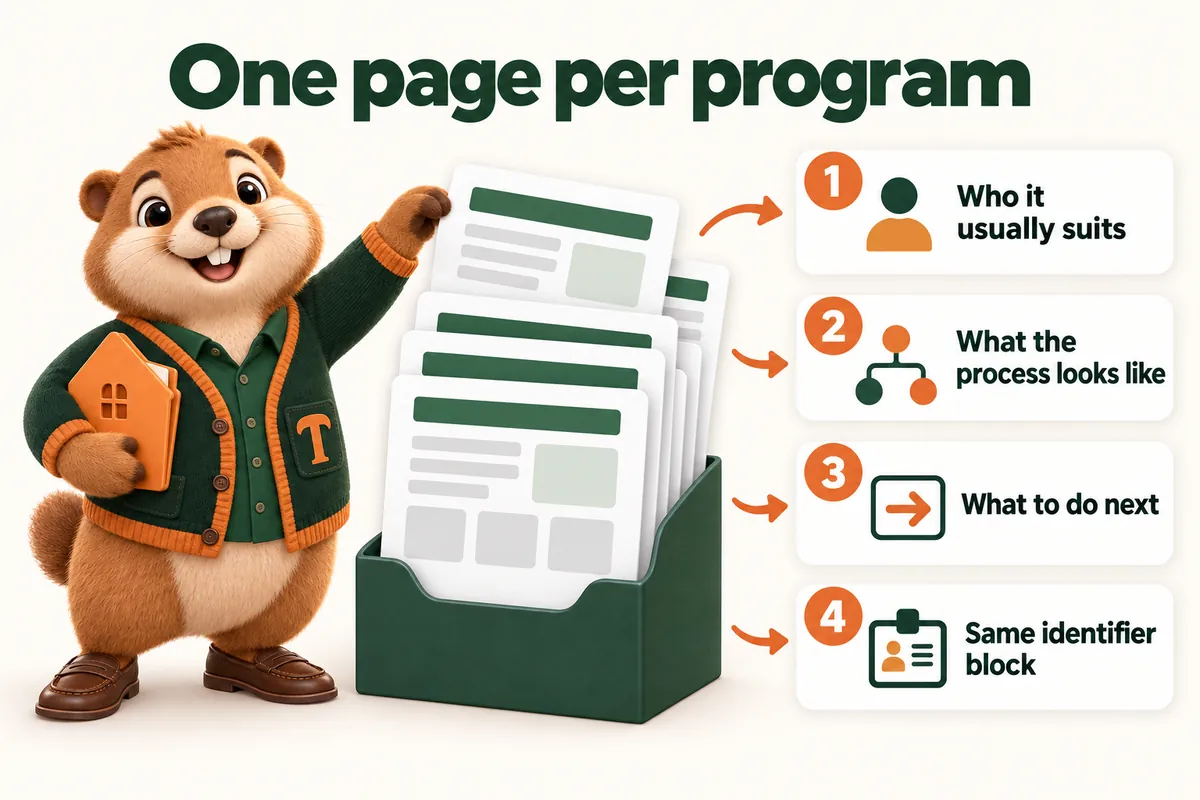
A loan program page earns its place when a borrower who was told “ask about the FHA option” can open one page, understand whether the program is usually a fit for someone like them, see what the process will ask of them, and start. That is the whole job. One page per program you originate, written in your words, checked by your compliance team, and linked to the application your lender already hosts. Everything else on the page is decoration.
Most mortgage websites get this wrong in the same way. There is a single page called “Loan programs” carrying nine headings and a paragraph each, usually pasted from a lender sheet. It cannot answer a borrower’s question because it never gets past the definition, and it cannot be found by someone searching for one program because it is competing with itself across nine topics. This article is about replacing that page with a set of pages that work, and about the parts of the job that belong to compliance rather than to the website.
Nothing here is lending, licensing or financial advice, and nothing here tells you what a disclosure must say. That is your compliance team’s call. What follows is the structure and the writing.
Why one page per program, and not one page with nine headings
A borrower arrives at a program page with a question that is narrower than “what mortgages exist”. They were told a phrase by an agent, a builder, a parent or a forum, and they want to know what it means for them. A combined page makes them scroll past eight programs that do not apply to reach three sentences that might.
The combined page fails a second time on the search side. Google’s own guidance on helpful content describes pages written for people who have a specific question, with enough depth to answer it. A section heading inside a general page can only ever carry a paragraph. A page can carry the question the borrower actually asked, the follow-up they ask next, and the objection they raise after that. That is the difference between a heading and a page.
There is a third reason, and it is the practical one. A program page is a thing you can send someone. When an agent calls and says a client is asking about a renovation loan, you have a link. When a past client asks whether their sibling qualifies for the thing they used, you have a link. A heading with an anchor is a link too, but it drops the reader into the middle of a page about eight other things, and they scroll away.
How many pages is the right number
As many as you originate and want more of. Not as many as your lender offers. A loan officer who places conventional, FHA, VA, jumbo and one renovation product has five pages, and every one of them can be written by someone who has closed that loan and knows what borrowers ask. A site that lists twenty programs because the lender sheet lists twenty is a site where nineteen pages are thin and one is real.
If you are a broker placing with many lenders, the count goes up, but the rule does not change: a page exists because you place that loan and can answer for it. A broker’s advantage is genuine choice, and program pages are where that choice becomes visible without the site reading like a lender portal.
What about programs you place rarely
Give them a section on a related page rather than a page of their own, and revisit it in six months. A rarely placed program that suddenly gets three inquiries has earned its page. One that gets none in a year was never going to rank and was never going to be sent to anybody.
The shape of a program page that works
Every program page on a well-built mortgage site has the same six parts in the same order. Sameness is the point: a borrower who reads two of your program pages should not have to learn a new layout the second time, and you should not have to design a page every time you add a product.
1. Who this is usually a fit for
The first thing under the heading answers the heading. Not the history of the program, not the agency that backs it. Who, in plain language, usually ends up using it, and what situation they are usually in. This is where you use the words borrowers use rather than the words the industry uses.
Write it as a description, never as a ruling. “Buyers who have been at the same employer for a couple of years and have a modest amount saved often look at this one” describes a pattern. “You qualify if you have two years of employment” is an eligibility statement, and eligibility is decided by underwriting against a file, not by a web page. The distinction matters to your compliance team and it will matter to you the first time a borrower quotes your page back at you.
2. What the process looks like from the borrower’s side
Borrowers are not afraid of the program. They are afraid of the process. A short, honest walk-through of what happens and roughly in what order removes more friction than any amount of reassurance. What you ask for first. What usually takes the longest. Where the borrower will be waiting on someone else. What a normal timeline feels like for this program compared with your other programs.
Avoid putting a number of days on it unless that number is something you control and stand behind. If your process reliably reaches a certain milestone in a certain time, say it and mean it. If it depends on an appraiser, a seller or an agency, say that instead. An honest “this one usually takes longer than a conventional purchase, and here is why” builds more trust than a timeline you will miss.
3. What to gather
This is the most useful and most skipped section on a mortgage website. A list of the documents a borrower will be asked for, written as a checklist they can act on tonight. Pay stubs. Bank statements. Identification. Anything specific to this program.
It works for three reasons. It gives a nervous borrower something to do, which converts anxiety into momentum. It shortens your own cycle, because a file that arrives with documents attached moves faster. And it is the kind of specific, practical content that gets bookmarked and forwarded, which is the most reliable signal a page is worth ranking.
4. The questions people actually ask
Five or six questions, each answered in a short paragraph, in the borrower’s language. Not a generic list. The questions you answer on the phone three times a week about this specific program.
Write the answer first and the caveat second. If the honest answer is “it depends on your file and your lender”, say that, then say what it usually depends on. A question with a non-answer is worse than no question at all, and a page full of them reads as evasive.
These questions are also the natural place for structured data. A frequently asked questions block that matches the visible text exactly can be marked up as FAQPage, and the rule there is simple: what a search engine sees must be what a reader sees. Marking up questions that are not on the page is a spam signal and it is also just lying.
5. What happens next
One paragraph and one link. The paragraph says what starting actually means: a conversation, a form, a document request, whichever is true for you. The link goes to the application your lender or point-of-sale vendor already hosts, carrying your originator identifier and, where the vendor supports it, the program.
Do not rebuild the application on the marketing site. Every mortgage application is a regulated, audited, integrated piece of software, and a form on a marketing site that collects the same information is a liability with none of the plumbing. The marketing site’s job is to get a comfortable, informed borrower to the real application with your name attached.
6. The identifier block
The same block on every page: company identifier, originator identifier, the states you are licensed in, the equal housing notice, and whatever else your compliance team specifies. Built once, published everywhere, changed in one place.
The Nationwide Multistate Licensing System publishes consumer-facing records through NMLS Consumer Access, and borrowers do look people up. Making your identifier easy to find is not only a compliance matter, it is a trust signal: the originator whose number is right there is the one who expects to be checked.
What never goes on a program page
Rates
A published rate turns a page into an advertisement under Regulation Z, and the regulation attaches required disclosures to triggering terms. That is a decision for your compliance team, not a design choice. Many originators decide the cost of getting it wrong outweighs the benefit and describe programs without publishing a rate, offering an estimator with a rate field the user or the originator controls instead.
Whatever your compliance team decides, the website has to make the decision cheap to change. If rates go on, they go in one component, sourced from one place, with the disclosure attached to that component. If they come off, they come off everywhere at once.
Eligibility rulings
“You are eligible if” is a sentence a web page cannot finish. Underwriting decides against a file. Anything on the page that sounds like a decision will be read as one, and the borrower who was told no after reading yes is a borrower you have lost and possibly a complaint you have earned.
Invented numbers
No percentage of borrowers, no average savings, no count of families helped, unless the number has a source you can point at and a date. This is worth being strict about, because the mortgage industry runs on numbers and an unsourced one on a marketing page undermines the sourced ones everywhere else.
Anything that reads as a guarantee
Approval language, “we will get you”, “guaranteed”. The page can be confident about what you do. It cannot be confident about what an underwriter will decide.
How program pages fit the rest of the site
A program page does not stand alone. On a well-structured mortgage site it sits in the middle of a small, deliberate set of links.
Down from the profile. Your originator profile lists the programs you place, each linking to its page. That is the path a referral takes: they search your name, land on you, and click the thing they were told to ask about.
Across to siblings. Each program page links to the two or three programs a reader of this one most often considers next. A borrower reading about a renovation product is often also weighing a standard purchase loan. Say so, and link it. This is genuinely useful and it also distributes internal links in a way that helps search engines understand which pages belong together.
Out to the estimator. One estimator, linked from every program page, ideally preset to that program’s inputs. The borrower gets a figure with the right starting assumptions, and you keep one component to label, one to maintain and one to wire into your system.
Out to the application. The single next step, on every page, in the same place.
Up to a location page, if you have branches. A branch or city page lists the programs originated there. That link matters for a multi-location business, because it connects the program vocabulary to the geographic vocabulary that local searches use.
The one page that ties them together
Keep a single index of programs, but make it a genuine index rather than the old combined page. A short line each, a link each, grouped the way you would group them when explaining to a borrower on the phone. It serves navigation and it gives search engines a clean map of the set. It just should not be where the content lives.
Writing the page: practical rules
Answer first. The first sentence under every heading answers that heading. Readers on a phone read the first sentence of a section and decide whether to read the second.
Short paragraphs, no walls. Three or four sentences. A program page is read standing up, in a kitchen, at the end of a long day.
Their vocabulary, not the industry’s. Borrowers say “putting money down”, not “loan to value”. Use their phrase, then the industry term once in brackets if the borrower will meet it later in the process. Teaching the word is a service. Assuming it is a barrier.
One voice. If you have five program pages and three were written by three different people, readers will feel it. Pick a voice and hold it.
Write for the person who is not sure they should be reading. A surprising share of mortgage traffic is people who think they are not ready. A sentence that tells them what to do if they are early is worth more than another paragraph of features.
Keeping them true after launch
Program pages rot faster than any other page on a mortgage site. Products change, lenders change, your mix changes. A page describing a program you stopped placing eighteen months ago is a page that generates inquiries you have to turn away.
Put a review rhythm in place and keep it small enough to actually happen. Once a quarter, walk the list: still placing it, still accurate, still the right set of questions. Twice a year, read one page end to end as a borrower would and fix what makes you wince.
The technical side matters too. A page that opens slowly on a phone loses the reader before any of this writing gets a chance. Google’s page experience guidance is clear that speed sits alongside content quality, and a mortgage site is nearly always opened on a phone from a text message. Static pages, very little script and nothing loading before the content is the practical answer.
Where this leaves you
Six pages written this way are worth more than twenty copied from a sheet. They are the pages you send when an agent calls, the pages a borrower reads at eleven at night before deciding to start, and the pages that give search engines something specific to match. They are also the least glamorous part of a mortgage website and the part that is skipped most often, which is exactly why doing them properly is worth the afternoon.
If you want the wider checklist that program pages sit inside, the loan officer website checklist covers the other four items. If you are working out where the pages should point once a borrower is ready, where mortgage inquiries go is about the wiring underneath.
Sources
Frequently asked questions
How many loan program pages should a mortgage website have?
One for every program you actually originate and want more of, and none for programs you do not place. A site with six honest program pages outperforms one with twenty thin pages copied from a lender sheet, because each of the six can be written by someone who has closed that loan and can answer what a borrower asks about it.
What should a loan program page contain?
Who the program is usually a fit for, what the process looks like from the borrower side, the documents they should expect to gather, the questions they usually ask, what happens next, and a single obvious way to start. It should not contain a rate, an eligibility ruling or anything that reads as an approval, because those belong to your compliance team and your underwriting, not to a web page.
Should each program page have its own calculator?
One estimator, reachable from every program page, is better than a different calculator on each. A single estimator is one thing to label correctly, one thing to wire into your CRM or LOS, and one thing to change when compliance asks. Program pages can preset the estimator, which gives the borrower the same convenience without multiplying the compliance surface.
Can I reuse the lender description of a program on my page?
You can, and it will read like every other page using the same text, which is exactly the outcome Google describes as unhelpful, copied content. The lender sheet is a good source for the facts you must not get wrong. The page a borrower reads should be your explanation of who the program suits and what the process feels like, written in your words and checked by your compliance team.
Do program pages help a loan officer rank?
They give search engines something specific to match against a specific question, which a single combined page cannot do. They also give you somewhere to send a referral who was told about one program. Rankings depend on many things outside a page, so treat a program page as the work you control, not as a promise of position.
Want a site like the one described here? Book a demo with MortgageWebStudio.